
Insights · 14 November 2026
The defence that never parades: why Italy needs cybersecurity technicians
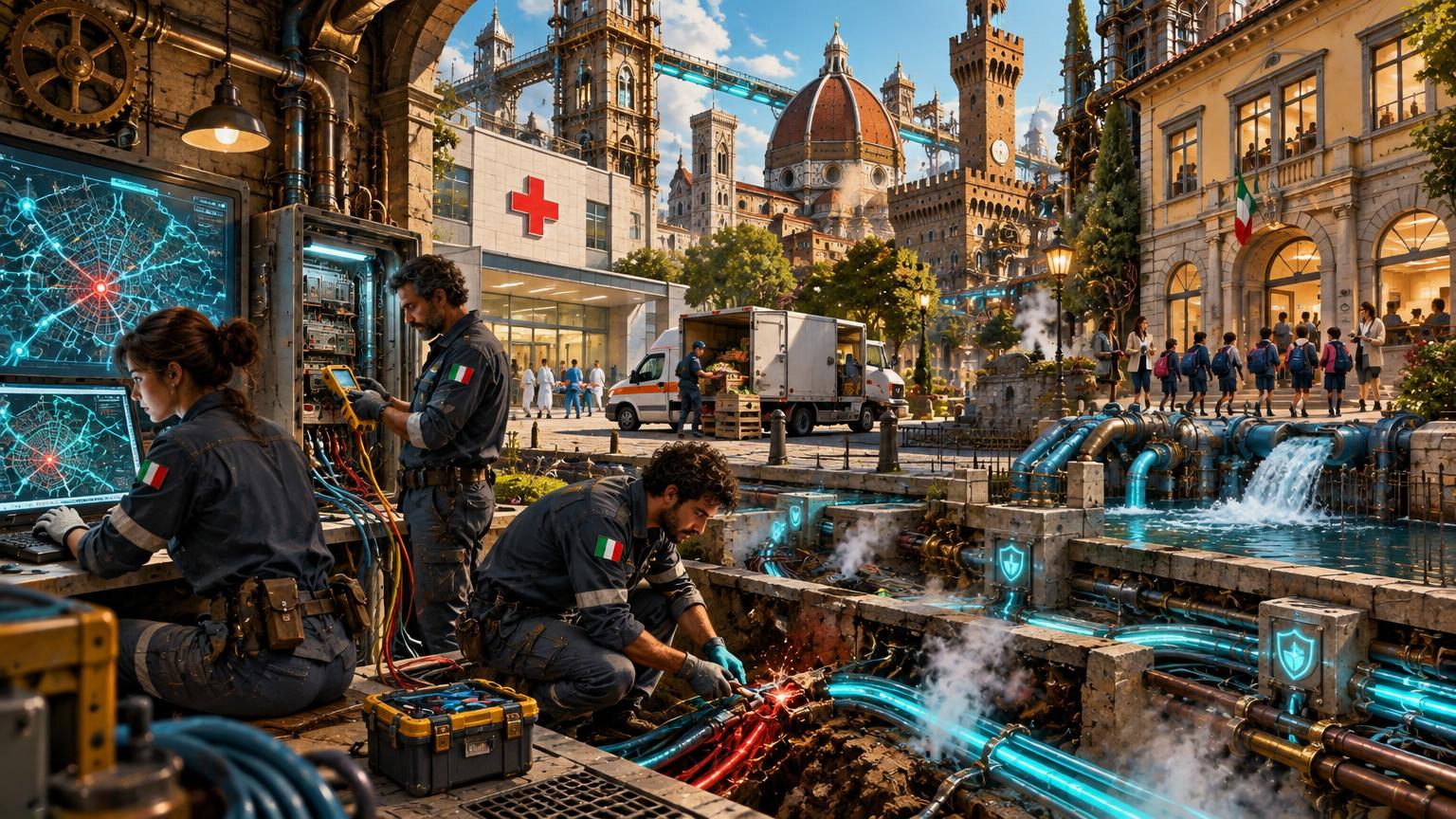
National security also runs through hospitals, schools, water systems and businesses. Shifting some resources from conventional weapons to digital defence means building skills, jobs and a new value chain. ITS Academies can be one of its engines.
Fear begins with ordinary things
The new insecurity does not necessarily sound like an explosion. It can be the silence of an inbox that stops updating. A school evacuated after a threat. A hospital forced to reschedule a service. The doubt that everything on which we built our day might suddenly stop working.
This fear is powerful because it enters everyday life. It does not ask us to understand an algorithm: it forces us to wonder whether we can still trust the most ordinary things.
Recent articles in Repubblica, La Stampa and Corriere della Sera describe different sides of this fragility: skills shortages, technological dependence, AI-enabled threats and coordination difficulties. They do not all describe the same phenomenon. But they pose the same question: who keeps the country running when its digital infrastructure fails?
Not everything is an attack. Everything requires preparation
The distinction matters. The Microsoft outage described by Fabrizio Goria in La Stampa is attributed to a technical problem, not a hacker attack. Threats sent to schools do not necessarily mean their systems have been breached. Confusing faults, intimidation and sabotage feeds headlines, not understanding.
The common issue is the continuity of collective life. A service can stop because of aggression or malfunction. Either way, people must understand what happened, contain the consequences, restore operations and communicate without creating panic. Cybersecurity and operational resilience are distinct, but must work together.
In Marco Varvello’s interview in La Stampa, Gareth Mott highlights the psychological dimension: creating disorder can cost little to the perpetrator and much to the victim. It is not only networks and devices that are targeted. It is trust.
AI changes the relationship between cost and damage
In Federico Fubini’s Corriere interview, Exein founder Gianni Cuozzo describes how AI can accelerate vulnerability discovery and make previously expensive actions economically viable. This is an industry leader’s assessment, not a formula that applies to every attack. But the strategic problem is real: when aggression becomes cheaper, more targets become attractive.
AI can also support defenders by analysing signals and detecting anomalies. It does not replace the responsibility of a person who must distinguish a false alarm from an incident, decide which services to isolate and assess the consequences.
Buying a tool does not mean acquiring a capability. Without technicians, even the best software risks becoming just another box with its lights on.
Defending a country means more than buying weapons
Security debates still focus mainly on vehicles, arsenals and conventional systems. Those capabilities cannot be dismissed with a slogan. But functioning hospitals, protected energy networks and reliable food distribution are also essential national interests.
I propose reallocating part of planned conventional weapons spending to threat analysis, prevention, countering attacks and training cybersecurity technicians. Not an indiscriminate transfer: a risk-based review of priorities that preserves defence commitments and makes objectives and results explicit.
This proposal is not automatically contained in the cited articles. It is the political and industrial conclusion we can draw from them. Digital defence should not be funded from whatever is left over: it needs strategic status and multi-year investment.
Antonio Fraschilla’s Repubblica analysis of 14 November reports €600 million allocated through the PNRR to public-administration cybersecurity and a €135 million forecast for 2027 within the scope described by the article. These are not Italy’s total cyber expenditure, nor figures directly comparable with the whole military budget. They nevertheless raise a decisive question: who funds maintenance, updates and people after exceptional programmes end?
Security does not end on inauguration day. It truly begins the day after.
ITS Academies: defence built from people
In Repubblica, Vittorio Colao stresses technical expertise and sustained investment. His call for more engineers and computer scientists should be broadened: higher-level technicians are also needed for the daily work that turns strategies into operations.
All ITS Academies investing in cybersecurity are building part of Italy’s civil and productive defence capability. They are not simply schools following a fashionable profession. They turn a national need into practical competence.
Examples are already visible. ITS INCOM, in the Insubria region, offers its two-year Cloud & Cybersecurity Systems Administrator programme in Busto Arsizio, covering secure cloud and hybrid infrastructure and privacy, with 840 hours in companies.
ITS DEMOS in Campobasso included Software Development and Cybersecurity with Artificial Intelligence in its official 2025–2027 call: a combination connecting software creation, protection and the new possibilities of AI.
Alongside them, ITS Academy ICT Piemonte offers Cyber Threat Analyst; ITS Angelo Rizzoli has developed Cyber Defence; ITS Academy Lazio Digital offers Cybersecurity Expert; and ITS Academy Apulia Digital includes cybersecurity among its specialist areas. These are documented examples, not a census or ranking. The recognition extends to the whole network working in this direction.
Their value is the bridge between education and business: laboratories, teachers familiar with operational problems and workplace experience. Universities train researchers, engineers and other essential professionals. ITS Academies help build the technical teams without which research and strategy cannot become daily protection. This is not a competition between qualifications: it is a chain of complementary skills.

From training to an Italian value chain
A monitoring centre needs analysts. A factory must protect industrial machines and networks. A municipality must manage access, updates and backups. A business needs to know whether its promised recovery plan actually works.
These needs can support an Italian value chain: monitoring, threat analysis, incident response, software security, device protection, SME support and product development. This does not mean making everything domestically. As Colao observes, autonomy must be selective and European in scale. It means being able to choose, verify and govern what we depend on.
Public procurement can help this growth through tenders accessible to specialist businesses and requirements that reward demonstrable capabilities. Changing a supplier’s nationality is not enough: quality, security and results must be verifiable.
Nor is training young people enough if we then offer them precarious contracts. The value chain breaks when the best people see no future in the sector.
A national agenda for 2027, with a decade-long perspective
2027 should not bring another isolated intervention, but the start of a strategy spanning governments and economic cycles. ITS Academies are an important part, not its whole scope. Institutions, businesses, universities, researchers, workers and citizens all have a role.
1. Rethink national security priorities. Assess reallocating part of conventional spending to cyber capabilities, with multi-year planning and clear responsibilities across defence, civil security and public administration. Strengthen national operational coordination and European threat-information sharing, avoiding duplication and gaps.
2. Put essential services first. Healthcare, energy, water, transport and food distribution need tested continuity plans, maintainable systems, recoverable backups and alternative procedures. The test is not owning a document: it is maintaining or restoring a service during an incident. Municipalities and SMEs also need affordable access to protection and expertise.
3. Build Italian and European industrial policy. Support applied research, startups and specialist businesses protecting software, devices and industrial plants. Use public procurement to reward verifiable solutions, interoperability and the ability to switch suppliers. Reducing critical dependence means retaining choice and control, not closing ourselves off from the world.
4. Broaden the skills base. Connect ITS Academies, universities, schools, research centres and lifelong learning rather than making them competitors. Train new technicians, upskill existing workers, make public and private careers attractive, and help leaders and citizens recognise risks. Security also means organisational culture, communication and trust.
5. Set a timetable and evaluate the strategy. In the first half of 2027, propose a shared map of vulnerabilities and priorities; in the second, launch coordinated programmes, authorised exercises and measurable investments. Publish a year-end account of results consistent with necessary confidentiality, then continue over a multi-year horizon. Detection and recovery times, successful restorations, protected services and industrial capabilities matter more than licence counts.

Sovereignty begins with those who can intervene
Insecurity becomes paralysing when we think everything depends on someone far away: a supplier, a platform or an attack we cannot interpret. Competence does not remove every risk. But it restores the possibility of action.
Italy can turn vulnerability into industrial policy: less passive dependence, more operational capability; fewer isolated purchases, more skilled jobs; less permanent emergency, more preparation.
ITS Academies working in cybersecurity are already contributing. It is time to recognise them not just as an opportunity for students, but as an investment in the country’s functioning.
The question for 2027 is not just how much we will spend defending ourselves. It is how many people will know how to do it.
Sources and editorial note
Original article based on the collected Repubblica, La Stampa and Corriere della Sera articles, without reproducing their full texts. Original source titles:
Giovanna Vitale, «Colao: “Serve un’accelerazione, più ingegneri e meno giuristi per affrontare la sfida hacker”», Repubblica, 13 novembre 2026.
Antonio Fraschilla, «Cybersicurezza spuntata: “Mancano specialisti e fondi per lavorare”», Repubblica, 14 novembre 2026.
Marco Varvello, «Allarmi bomba, Gareth Mott: “Prepariamoci all’emergenza: in casa acqua, cibo, la radio. È prudenza”», La Stampa, 14 novembre 2026.
Fabrizio Goria, «Microsoft, il blackout più lungo: fino a mezzo miliardo di danni», La Stampa, 14 novembre 2026.
Federico Fubini, «L’ex hacker Cuozzo: “L’intelligenza artificiale rende gli attacchi informatici molto più facili. Le difese? Italia ed Europa sono all’anno zero”», Corriere della Sera / Whatever it takes. Data non indicata nell’estratto consultato.
All three images are AI-generated cyberpunk and steampunk illustrations, not real events.