
Digital culture · 18 November 2026
Writing with artificial intelligence: the right distance, without fear
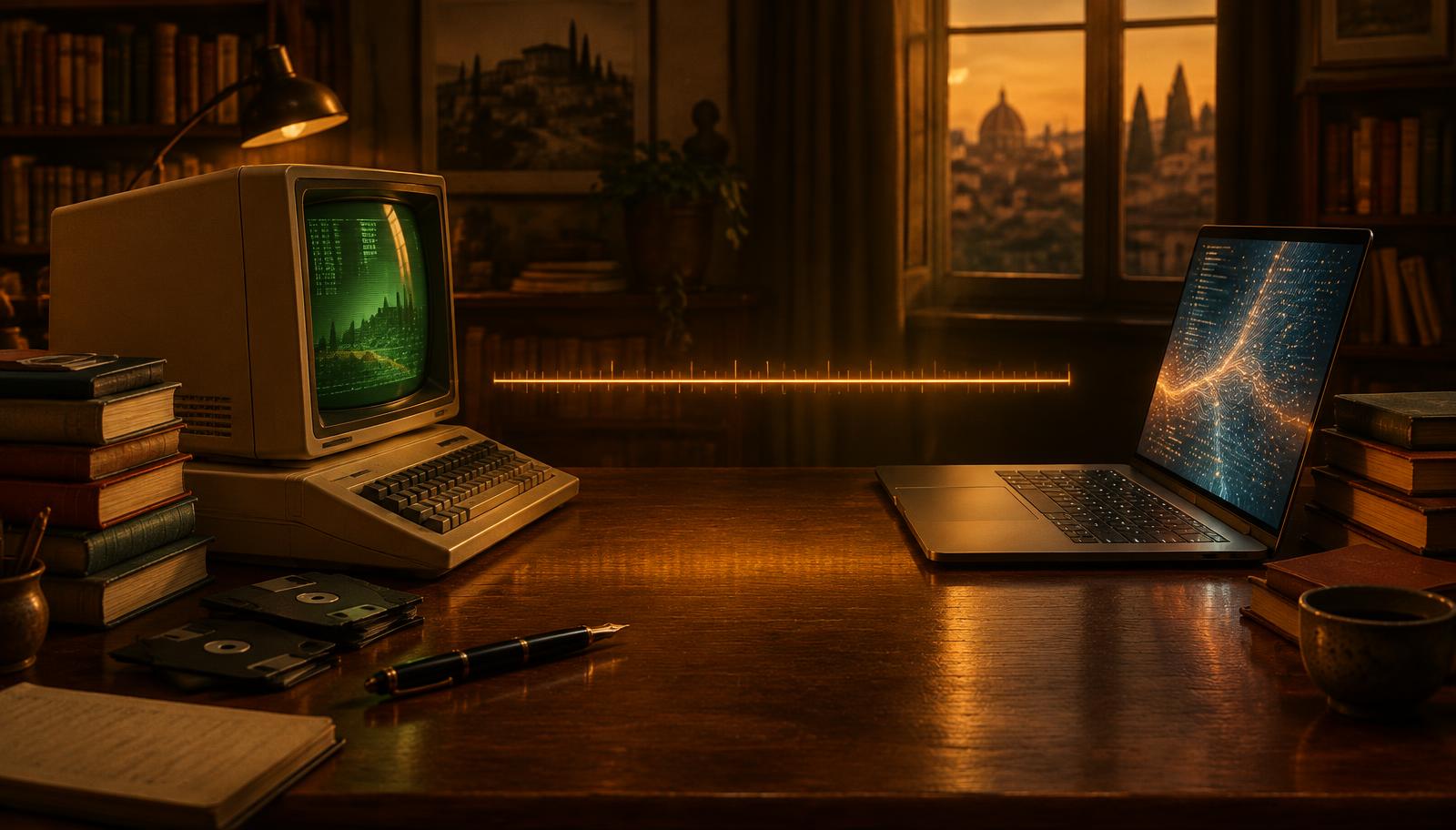
Starting from Luciano Floridi, a reflection on the boundaries we need when writing with AI, without demonising a valuable working tool. And a memory of the pioneers who learned to write at a computer terminal in the 1980s.
A prize, a suspicion, a question
The Prix Goncourt excluded a candidate suspected of writing with the help of artificial intelligence. The news reignited a debate running through newsrooms, universities, offices and publishers: is writing with AI cheating?
In la Repubblica, Luciano Floridi offers an answer worth reading carefully. Writing with AI, he argues, is a matter of the right distance. The tool does not in itself erase the writer, provided the difference between creativity and authorship is clear: whoever signs a text answers for it, chooses it and claims it.
The distinction matters because it moves the discussion from suspicion to responsibility. The question is no longer only “did you use the machine?”, but “how much of this text is yours — in its choices, its judgement, its voice?”.
Drawing boundaries, not building walls
Clear boundaries are necessary. A literary prize may set its own rules; a school must know what it is assessing; a newspaper must assure readers that behind a byline is a person who checked, thought and decided. Transparency about tools will increasingly become a form of respect.
But a boundary is not a wall. Demonising AI would mean giving up a hugely important working tool: for organising notes, finding the structure of an argument, testing a thesis, translating, summarising long documents and making complex texts accessible. In these tasks the machine does not replace thinking — it accompanies it and, used well, makes it more demanding.
The right distance is a practice more than a rule: close enough to use the tool, far enough not to hand it our judgement.
When pioneers wrote at the terminal
This is not the first time a machine has entered the writer’s study amid enthusiasm and alarm. In the mid-1980s the personal computer was bulky and viewed with suspicion. Anyone writing at a terminal — floppy disks, green phosphor screens, commands learned by heart — was a pioneer.
Umberto Eco was among the first Italian intellectuals to describe that experience with curiosity and irony. In his preface to Claudio Pozzoli’s handbook on writing a thesis with a personal computer (Rizzoli, 1986), he wrote that the computer “is not an intelligent machine that helps stupid people; it is a stupid machine that works only in the hands of intelligent people”. He called the word processor a “very spiritual” machine that lets you write at the speed of thought and encourages, “perhaps too much”, revision and perfectionism.
In Foucault’s Pendulum (1988) Eco even named his character Belbo’s computer: Abulafia, a machine for playing with textual combinations. It captured an era in which writers tested the tool, mocked it, feared its effects and discovered its possibilities.
Those fears now make us smile: nobody thinks a novel written with a word processor is worth less than a typewritten one. Yet the lesson still holds. The machine was “stupid” and worked in intelligent hands. With AI the machine seems far less stupid — which is precisely why the hands, and the mind, matter even more.
How professional writers write
The most useful contributions today come from people who openly describe how they use these tools. On his podcast PDR, writer Daniele Rielli has described a precise method, far from both rejection and uncritical enthusiasm.
It starts with a prompt: the outline of a situation, a context or a simple narrative idea. He then asks the AI to quickly develop the scene, describing the setting, sensory details and the dynamics between characters.
The aim is not to copy that text, which he often finds flat or derivative, but to “enter the moment”: reading it to visualise the space, feel the temperature of the scene and immerse himself in the situation. Then comes a complete rewrite: once the atmosphere is captured, he discards the machine’s text and writes the page from scratch in his own voice and style.
It is a perfect example of the right distance. The machine becomes a kind of location scouting for the imagination; the page, the choices and the responsibility remain entirely the author’s — exactly Floridi’s distinction between creative contribution and authorship.
Sharing one’s method may be the best way to build trust: not hiding the tool, but showing where its work ends and ours begins.
After excess, balance
Every major technology goes through a phase of overuse. It happened with word processing, email and social networks: first the binge, then rules, habits and taste. We are probably still in the first phase, using AI everywhere, even where it is not needed, producing texts that feel uniform and anonymous.
This phase is likely to pass. Readers will learn to recognise writing without an author and reward writing with a voice; organisations will define good practice; schools and universities will teach methodical use, as they once taught how to use a library or a computer.
Balance will come neither from bans nor from blind adoption, but from experience. Like the personal computer pioneers, we will learn what the machine does better than us, what it does worse and what it must not do in our place.
Annoluce’s position
Annoluce works with artificial intelligence every day — in training, ICT consulting and projects for businesses and ITS Academies. That is why we believe the tool should be understood, not feared, and that the best rules come from people who use it consciously.
The right distance is not a safety distance. It is the position from which you see best: close enough to work, far enough to remain the author.