ITS 4.0 · 2026 · Fondazione ITS DEMOS Academy · Annoluce ICT Consulting
Micro Digital Twin
Simulate heat-reduction interventions before implementing them. A micro digital twin to compare urban cooling scenarios and explore how to make public spaces more liveable, supported by AI and predictive models.
Micro Digital Twin · App
Download the app and try the project
Explore urban cooling scenarios, compare interventions and discover Micro Digital Twin. The app link and instructions for downloading or installing it on your device will be available here.
Download and instructions coming soon.
The story
The project, step by step
Cooling the city without air conditioning
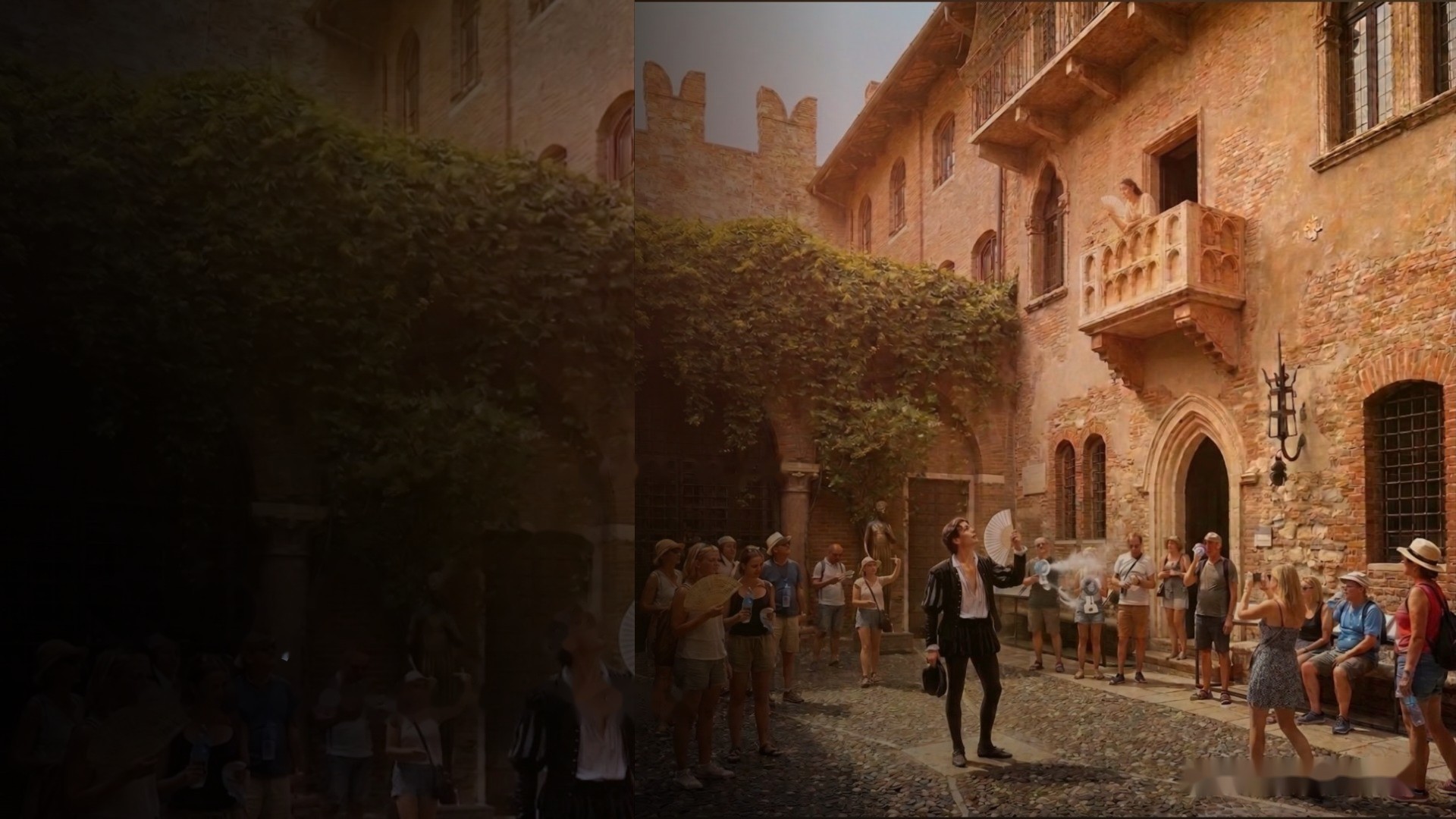
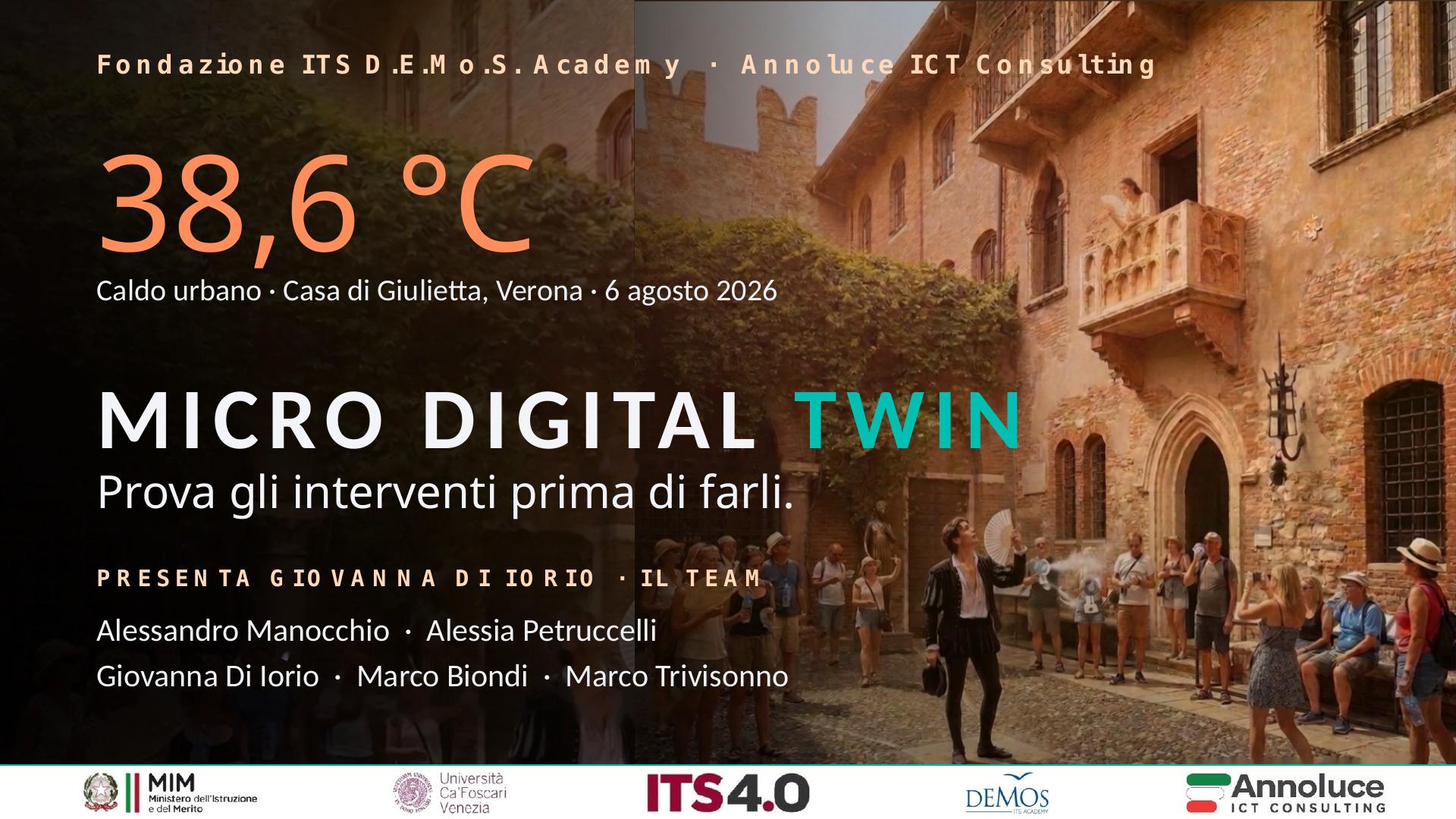
The project starts with heat in public spaces: the pitch associates Juliet’s House in Verona on 6 August 2026 with 38.6 °C. Shade, vegetation and light-coloured surfaces are passive cooling measures: they reduce sun exposure, promote evapotranspiration and limit heat accumulation. The question is which combination to choose before implementing interventions.
From a goal to a decision
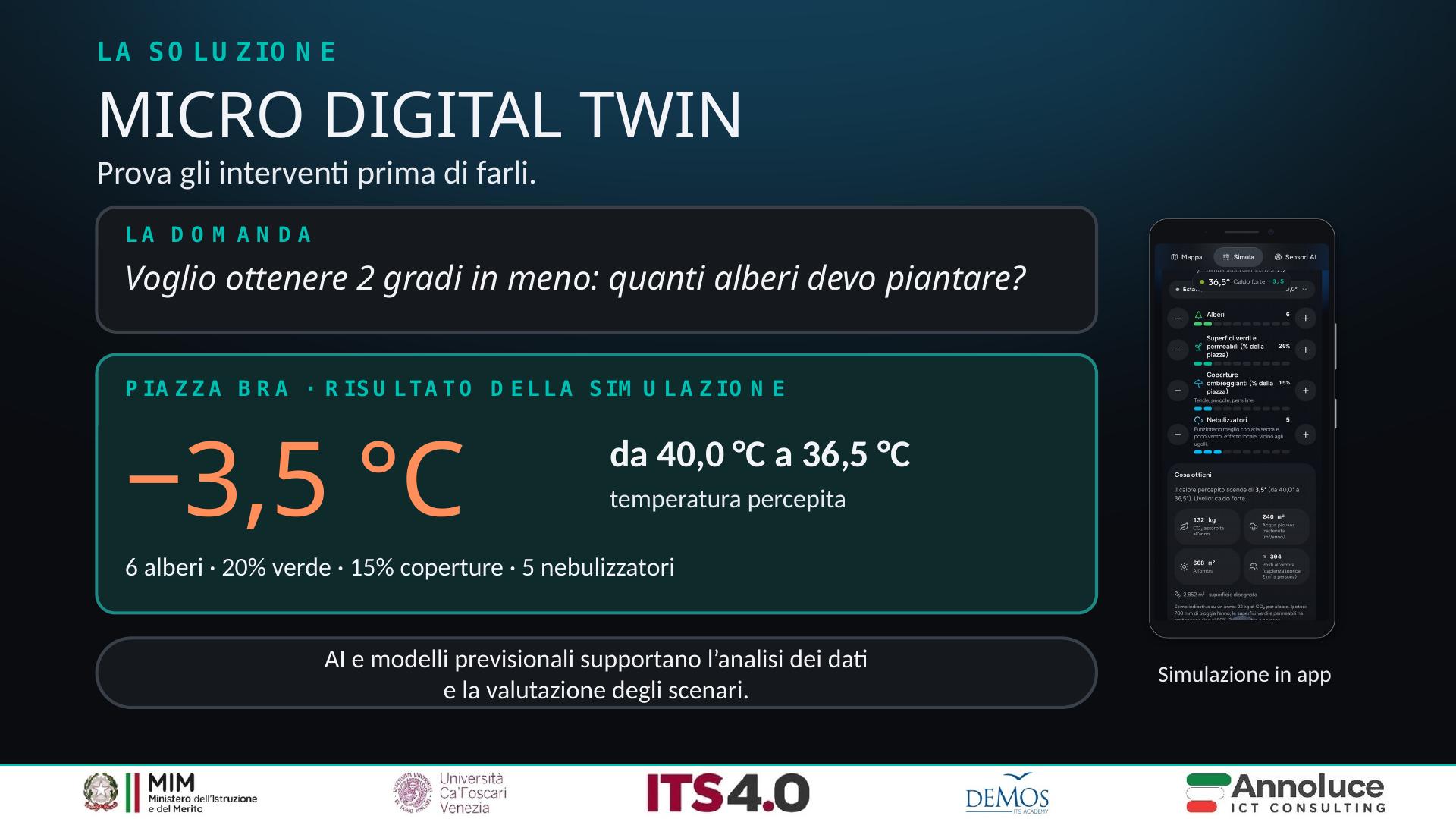
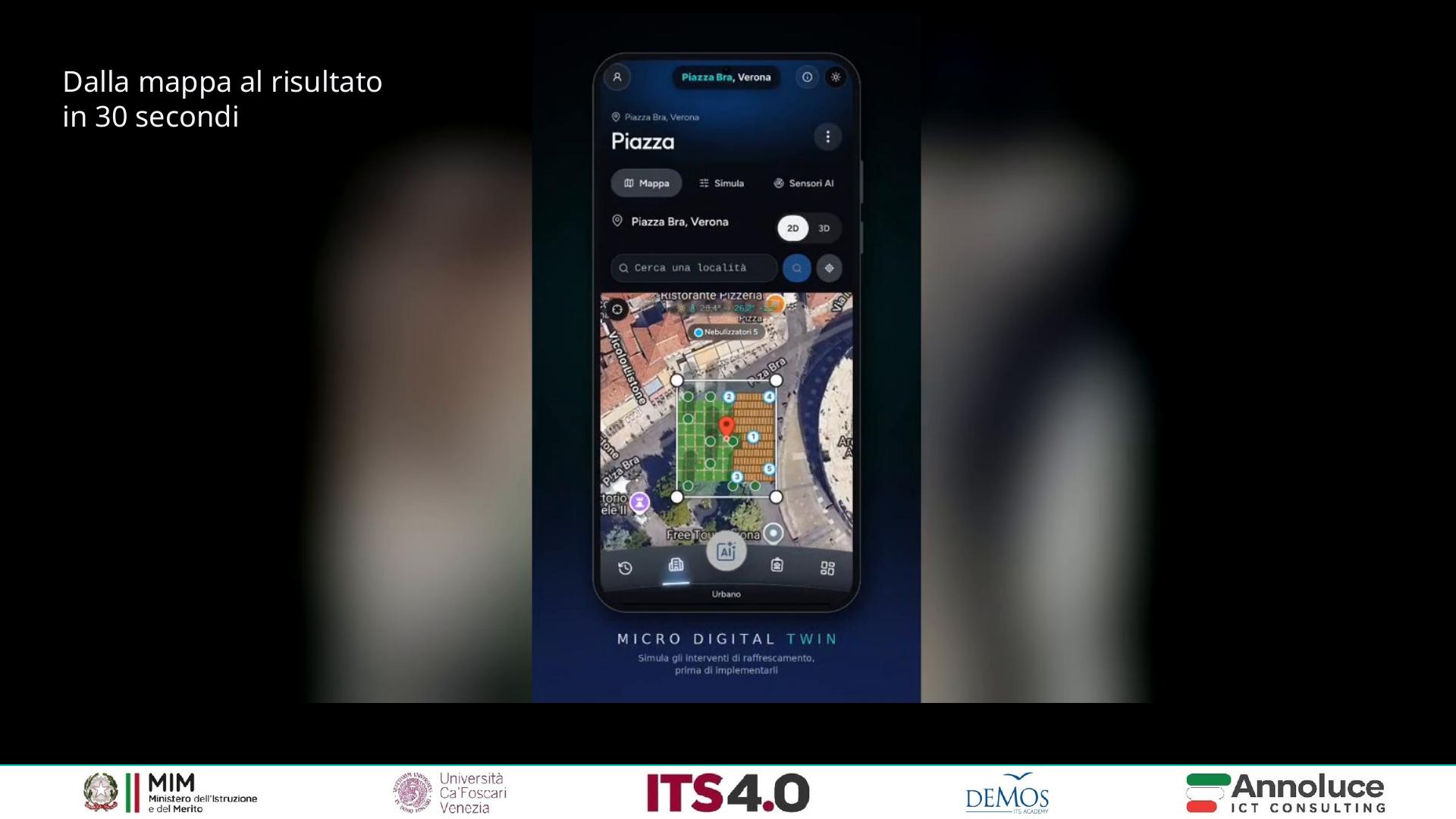
“I want to achieve two degrees less: how many trees should I plant?” Micro Digital Twin turns this question into a workflow: area, interventions, impact, comparison and report. Users select a space on the map and build scenarios with trees, greenery, shade structures and misting devices. AI and predictive models support data analysis and the evaluation of alternatives.
Piazza Bra: a simulated scenario
The presentation shows a trial scenario for Piazza Bra in Verona: six trees, 20% greenery, 15% shade structures and five misting devices. The simulation indicates a perceived temperature decrease from 40.0 °C to 36.5 °C, a reduction of 3.5 °C. This is a simulated result shown in the pitch, not a measured reduction after completed works.
A tool for those who design cities
Municipal technicians, public authorities, architects, engineers, urban planners and green-space managers need to compare alternatives and justify costs before taking action. User feedback highlighted the need to document thermal benefits and costs before launching a tender: the project therefore added scenario report export.
The team and ITS 4.0 programme
Micro Digital Twin is presented by Fondazione ITS DEMOS Academy and Annoluce ICT Consulting within ITS 4.0. Giovanna Di Iorio presents the work of a team comprising Alessandro Manocchio, Alessia Petruccelli, Giovanna Di Iorio, Marco Biondi and Marco Trivisonno. The presentation references the Italian Ministry of Education and Merit, Ca’ Foscari University of Venice and ITS 4.0.
Development and next steps
The proposed business model combines a freemium trial, professional subscription and pay-per-use simulation credits, with pricing still being defined. The pitch roadmap includes a POC presentation at Job&Orienta in Verona on 25 November 2026, a meeting with TECNALIA in Bilbao in January 2027, an Alpha version in February and a Beta with pilot users in June 2027. Planned developments include camera input, AI/IoT sensors, before/after 3D views and collaborative workflows.
Photos
Images from the project
Slides
The project presentation
Have a project in mind?
Tell us what you need: together we will design the right solution.